
You've probably scrolled past dozens of air fryer recipes promising crispy, delicious results with fewer calories than traditional cooking methods. But here's what most home cooks miss: not all air fryer recipes are automatically low calorie, and understanding how to accurately count calories in these dishes is essential for maintaining your health goals. The confusion stems from the fact that calorie counts vary dramatically based on ingredients, cooking techniques, and added fats. This guide will walk you through everything you need to know about calorie counting in air fryer recipes, from basic definitions to practical calculation methods, so you can make informed decisions about your meals without sacrificing flavor or satisfaction.
Table of Contents
- Key Takeaways
- What calorie count means in air fryer recipes
- How to calculate calorie count in air fryer recipes
- Comparing calorie counts: air frying vs traditional cooking methods
- Tips for finding and using calorie counts in air fryer recipes
- Discover calorie-counted air fryer recipes with AirFry Pro
- FAQ
Key Takeaways
| Point | Details |
|---|---|
| Calories vary by ingredients | Calorie totals depend on the raw ingredients, how much oil or spray you apply, and any added fats or coatings. |
| Air frying reduces oil use | Compared with traditional frying, air frying uses less oil and can lower calorie counts while preserving texture. |
| Precise measurement matters | To calculate true calories you must weigh each solid and measure liquids and account for oils marinades and coatings. |
| Tracking supports healthier choices | Tracking calories helps with portion control and nutrient balance, guiding smarter meal choices. |
What calorie count means in air fryer recipes
When you see a calorie count listed on an air fryer recipe, you're looking at the total energy content that food provides to your body, measured in kilocalories. Calories measure the energy food provides, crucial for managing weight and health. Understanding this number matters because it directly impacts your ability to maintain, lose, or gain weight based on your personal health goals.
Air fryer cooking fundamentally changes the calorie equation compared to traditional methods. The primary advantage lies in the dramatic reduction of oil needed to achieve crispy, golden results. While deep frying requires submerging food in hot oil, air fryers circulate superheated air around ingredients, creating that satisfying crunch with just a light mist of cooking spray or a teaspoon of oil. This shift can transform a 500-calorie plate of fried chicken into a 250-calorie air fried version without compromising taste or texture.
However, there's a critical distinction you need to grasp: the calorie count of raw ingredients differs from the finished cooked dish. When you calculate calories for an air fryer recipe, you must account for several variables that affect the final number. Added fats like oil sprays, marinades containing sugar or honey, breading mixtures, and even the natural fat that renders out during cooking all play a role. Some recipes might seem healthy at first glance but pack hidden calories in sauces or coatings.
Several factors influence the final calorie count in your air fryer meals:
- Ingredient quality and fat content, such as choosing chicken breast versus thighs
- Amount and type of oil or cooking spray applied before air frying
- Breading or coating ingredients like flour, breadcrumbs, or panko
- Marinades and seasonings that may contain sugars or fats
- Cooking temperature and time, which affect moisture loss and concentration
The health benefits of monitoring calories in your air fryer meals extend beyond simple weight management. When you track what goes into each dish, you become more aware of portion sizes, macronutrient balance, and how different ingredients contribute to your overall nutrition. This awareness naturally leads to better food choices. You might discover that swapping regular potatoes for sweet potatoes adds beneficial nutrients while maintaining similar calorie counts, or that using air fryer for healthy meals opens up creative possibilities you hadn't considered.
How to calculate calorie count in air fryer recipes
Calculating accurate calorie counts for your air fryer recipes doesn't require advanced math skills, just attention to detail and a systematic approach. Follow these steps to ensure you're tracking calories correctly:
- Start by gathering nutritional information from food packaging labels or trusted databases like the USDA FoodData Central for each raw ingredient in your recipe.
- Measure each ingredient precisely using a kitchen scale for solids and measuring cups for liquids, since eyeballing portions leads to significant calorie estimation errors.
- Record the calories for the exact amount of each ingredient you're using, not the serving size listed on the package unless they match perfectly.
- Add up the calories from any cooking oils, butter, or sprays you apply before or during air frying, remembering that even a quick spray contains 5-10 calories.
- Account for the cooking process by understanding that air frying with minimal oil means most ingredient calories remain in the final dish, unlike deep frying where some oil is absorbed.
- Sum all ingredient calories to get your total recipe calorie count, then divide by the number of servings to determine per-serving calories.
- Double-check your math and consider using nutrition tracking apps like MyFitnessPal or Cronometer to simplify the process and catch calculation errors.
Using nutritional databases and food labels is a reliable way to estimate calorie content of air fryer recipes. These resources provide standardized values based on scientific testing, giving you confidence in your calculations. When you can't find exact matches for specialty ingredients, choose the closest equivalent and make a note for future reference.
Portion sizes deserve special attention because they're where most home cooks inadvertently add extra calories. A recipe serving four people should yield four equal portions, but if you're eyeballing servings, you might end up with three larger portions that each contain 33% more calories than calculated. Invest in a simple kitchen scale and weigh finished dishes before dividing them to ensure accuracy.

Pro Tip: When measuring cooking oil for air fryer recipes, use a spray bottle with a measured pump or pour oil into a measuring spoon rather than spraying directly from an aerosol can. Most cooking sprays claim zero calories per serving, but that's only because the serving size is a fraction of a second spray. A typical two-second spray actually contains about 10-15 calories, and if you're generous with application, those calories add up quickly across multiple meals.
The air fryer time and temperature guide helps you understand how cooking variables affect moisture loss and calorie concentration. Higher temperatures for shorter times tend to preserve more moisture, while lower temperatures for longer periods can cause more water evaporation, slightly concentrating calories per gram of finished food. This difference rarely exceeds 5-10%, but for precise tracking, it's worth noting.
Comparing calorie counts: air frying vs traditional cooking methods
The calorie difference between air frying and traditional cooking methods often surprises home cooks who haven't done a side-by-side comparison. Oil absorption is the primary variable that separates these techniques. Deep frying submerges food in hot oil, and even with proper draining, a significant amount of fat clings to the surface and soaks into porous foods like breaded chicken or french fries. Baking and roasting typically require moderate amounts of oil to prevent sticking and promote browning. Air frying can reduce calorie content by 70-80% compared to deep frying due to minimal oil use.
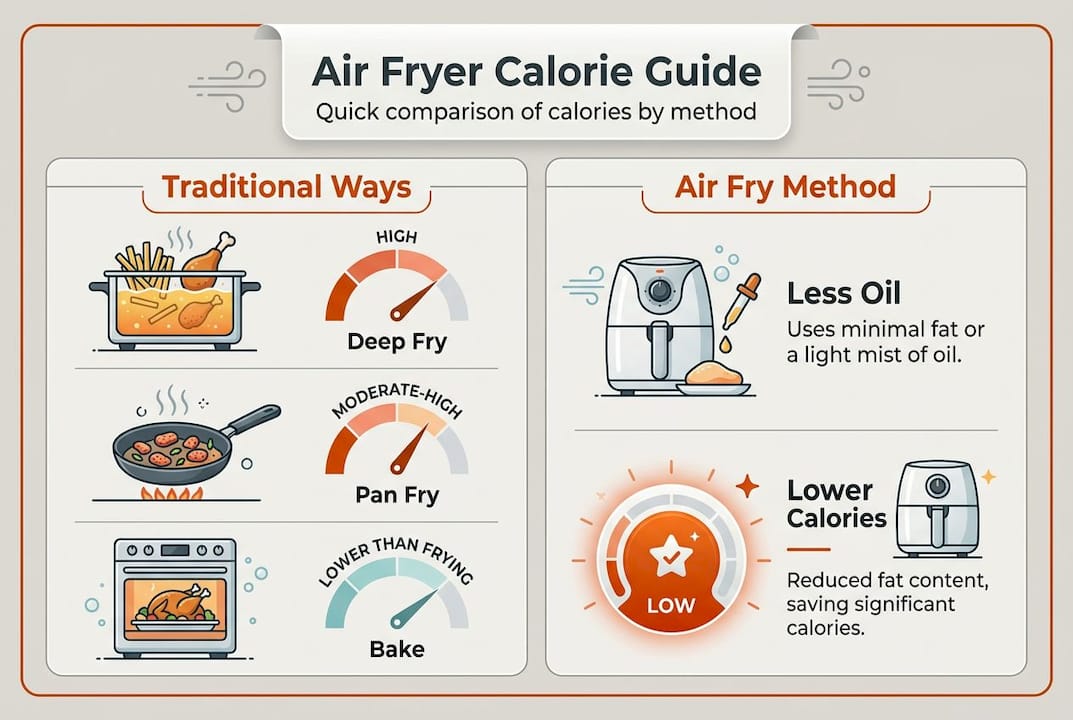
Here's how popular dishes compare across different cooking methods:
| Dish | Deep fried | Pan fried | Baked | Air fried |
|---|---|---|---|---|
| Chicken wings (6 pieces) | 480 calories | 380 calories | 320 calories | 290 calories |
| French fries (4 oz) | 380 calories | 320 calories | 220 calories | 180 calories |
| Breaded fish fillet | 340 calories | 280 calories | 240 calories | 210 calories |
| Mozzarella sticks (6 pieces) | 420 calories | 360 calories | 300 calories | 260 calories |
These numbers reveal that air frying consistently delivers the lowest calorie counts while maintaining the crispy texture people crave. The reduction comes almost entirely from decreased oil absorption. When you deep fry chicken wings, they can absorb 50-80 grams of oil during cooking. Air fried wings might use 5-10 grams total, applied as a light coating before cooking.
Several scenarios exist where air fryer calorie counts might approach other cooking methods:
- Recipes requiring heavy breading or batter that naturally contains significant calories
- Dishes made with inherently fatty ingredients like bacon or sausage where added oil is minimal
- Preparations using oil-based marinades that coat food before air frying
- Recipes calling for cheese or creamy sauces where cooking method has little impact on total calories
Cooking time and temperature influence calorie retention in subtle ways. Higher heat causes faster moisture evaporation, which can slightly concentrate calories per gram of finished food. A chicken breast that loses 20% of its weight through moisture loss will have calories more densely packed in the remaining 80%, but the total calorie count of the piece hasn't changed. This matters for portion control because a smaller, denser piece might not feel as satisfying as a larger, moister one with the same calories.
The texture and flavor benefits of air frying make it easier to stick with lower-calorie versions of favorite foods. When crispy air fryer vegetable recipes deliver the satisfying crunch you want without excess oil, you're more likely to choose vegetables over higher-calorie options. This psychological advantage shouldn't be underestimated in long-term healthy eating success.
Tips for finding and using calorie counts in air fryer recipes
Finding reliable air fryer recipes with accurate calorie information requires knowing where to look and how to evaluate sources. Not all recipe websites provide nutritional data, and when they do, the accuracy varies based on their calculation methods and ingredient assumptions.
Start your search with these trusted resources:
- Dedicated air fryer recipe sites like AirFry Pro that include detailed calorie counts and nutritional breakdowns for every recipe
- Cookbooks from registered dietitians or nutritionists specializing in air fryer cooking and healthy meal preparation
- Food blogs run by certified nutrition professionals who verify their calorie calculations
- Recipe apps with built-in nutrition calculators that automatically compute calories based on ingredients you input
When you find a recipe without calorie information, you can adapt it by calculating ingredient calories yourself using the method outlined earlier. This skill empowers you to cook anything while maintaining calorie awareness. Keep a notebook or digital file of your calculations so you don't have to repeat the work when you make the same recipe again.
Tracking calories consistently requires a system that works for your lifestyle. Some people prefer traditional food journals where they write down everything they eat, while others find apps more convenient. Popular options like Lose It, Nutritionix, or MyFitnessPal let you save custom recipes, scan barcodes, and track meals with just a few taps. The best system is the one you'll actually use every day.
Common pitfalls sabotage even well-intentioned calorie tracking efforts:
- Underestimating cooking oil by assuming a quick spray adds negligible calories
- Forgetting to account for toppings like sour cream, cheese, or dipping sauces that can add 100-200 calories
- Using inaccurate portion sizes by skipping the scale and guessing serving amounts
- Neglecting to update calorie counts when you substitute ingredients or adjust recipe quantities
Pro Tip: Batch cooking in your air fryer makes calorie management easier because you can calculate the total recipe calories once, divide the finished food into equal portions using a scale, and store them in individual containers labeled with the calorie count. This approach eliminates daily calculation work and removes the temptation to eat larger portions. When you grab a pre-portioned container from the fridge, you know exactly what you're consuming without any mental math or estimation.
Choosing recipes with known calorie counts helps maintain healthy eating goals when using an air fryer. This strategy reduces friction in your daily routine because you don't have to calculate every meal from scratch. Build a rotation of 10-15 favorite recipes with verified calorie counts, and you'll have a reliable foundation for meal planning.
Specific recipes like air fryer frozen french fries and juicy air fryer chicken breast demonstrate how straightforward calorie tracking becomes when you follow tested recipes. These dishes provide baseline calorie counts you can use as reference points when creating your own variations.
Discover calorie-counted air fryer recipes with AirFry Pro
Now that you understand how to calculate and track calories in air fryer recipes, you need a reliable source for recipes that have already done the work for you. AirFry Pro specializes in providing home cooks with a comprehensive collection of air fryer recipes, each accompanied by detailed calorie counts and complete nutritional information. Every recipe includes step-by-step instructions, optimal temperature settings, and cooking times that ensure consistent results.

The platform features hundreds of recipes spanning every meal category, from breakfast items and appetizers to main courses and desserts. Whether you're craving air fryer frozen french fries for a quick side dish or juicy air fryer chicken breast for a protein-packed dinner, you'll find options that fit your calorie goals without sacrificing flavor. The AirFry Pro recipe collection grows weekly with new additions, giving you fresh ideas to keep your healthy eating plan exciting and sustainable. Beyond recipes, the site offers practical guides and tips that help you master your air fryer and make the most of this versatile cooking tool.
FAQ
What is the average calorie count for air fryer recipes?
Average calorie counts for air fryer recipes typically range from 150 to 400 calories per serving, depending on the main ingredients and recipe complexity. Lean proteins like chicken breast or fish combined with vegetables tend to fall on the lower end, while recipes featuring cheese, breading, or starchy sides like potatoes land higher. Individual recipes vary significantly based on portion sizes and preparation methods.
Does air frying always reduce calories compared to deep frying?
Air frying typically reduces calories because it requires minimal oil, but the reduction isn't automatic for every recipe. If you add significant amounts of butter, oil-based marinades, or high-calorie coatings, the final dish might contain comparable calories to other cooking methods. The calorie advantage comes specifically from eliminating oil absorption, so recipes with inherently fatty ingredients see less dramatic reductions.
How accurate are calorie counts in air fryer recipes?
Calorie counts in recipes are estimates based on standard ingredient measurements and nutritional databases, with accuracy depending on how closely you follow the recipe. Variations in ingredient brands, portion sizes, and actual amounts of oil used can cause your results to differ by 10-20% from published counts. Using a kitchen scale for precise measurements and tracking your specific ingredients improves accuracy significantly.
Can I modify air fryer recipes to lower calories?
You can easily modify most air fryer recipes to reduce calories by adjusting ingredients and portions. Swap regular oils for cooking spray, choose leaner cuts of meat, reduce or eliminate cheese and creamy sauces, and increase the proportion of vegetables to protein. Fresh herbs, spices, and citrus add flavor without calories, letting you create satisfying meals that align with your dietary goals.